Four hotels featuring design work by Jean-Michel Gathy and Denniston appear in The 50 Best Hotels 2026 rankings, led by Four Seasons Bangkok at No. 3.
Aman Nai Lert Bangkok makes its debut at No. 48. Janu Tokyo ranks No. 52 and Aman New York No. 87, placing both on the extended 51–100 list. Two of the four Gathy projects are in the main top 50.
Bangkok had a good year across the ranking. Four Seasons Hotel Bangkok at Chao Phraya River sits immediately behind Capella Bangkok at No. 2, while Mandarin Oriental Bangkok takes No. 10. With Aman Nai Lert, that puts four Bangkok hotels in the main list.
The ranking covers the hotels as a whole, rather than design alone. The 50 Best Hotels says an academy of more than 800 experts casts the votes, with seven votes per member. Hotels cannot pay to enter or nominate themselves. The extended list was published on 1 September, followed by the top 50 at a ceremony in Paris on 15 September.
For Gathy, the results follow an Outstanding Achievement Award at Global Hospitality Talk in Bangkok earlier this month. The Belgian-born designer founded Denniston in 1983. Across these four hotels, the work ranges from a wide Bangkok riverfront to a historic building on Fifth Avenue, with each property shaped around a different kind of city stay.
Four Seasons Hotel Bangkok at Chao Phraya River, No. 3
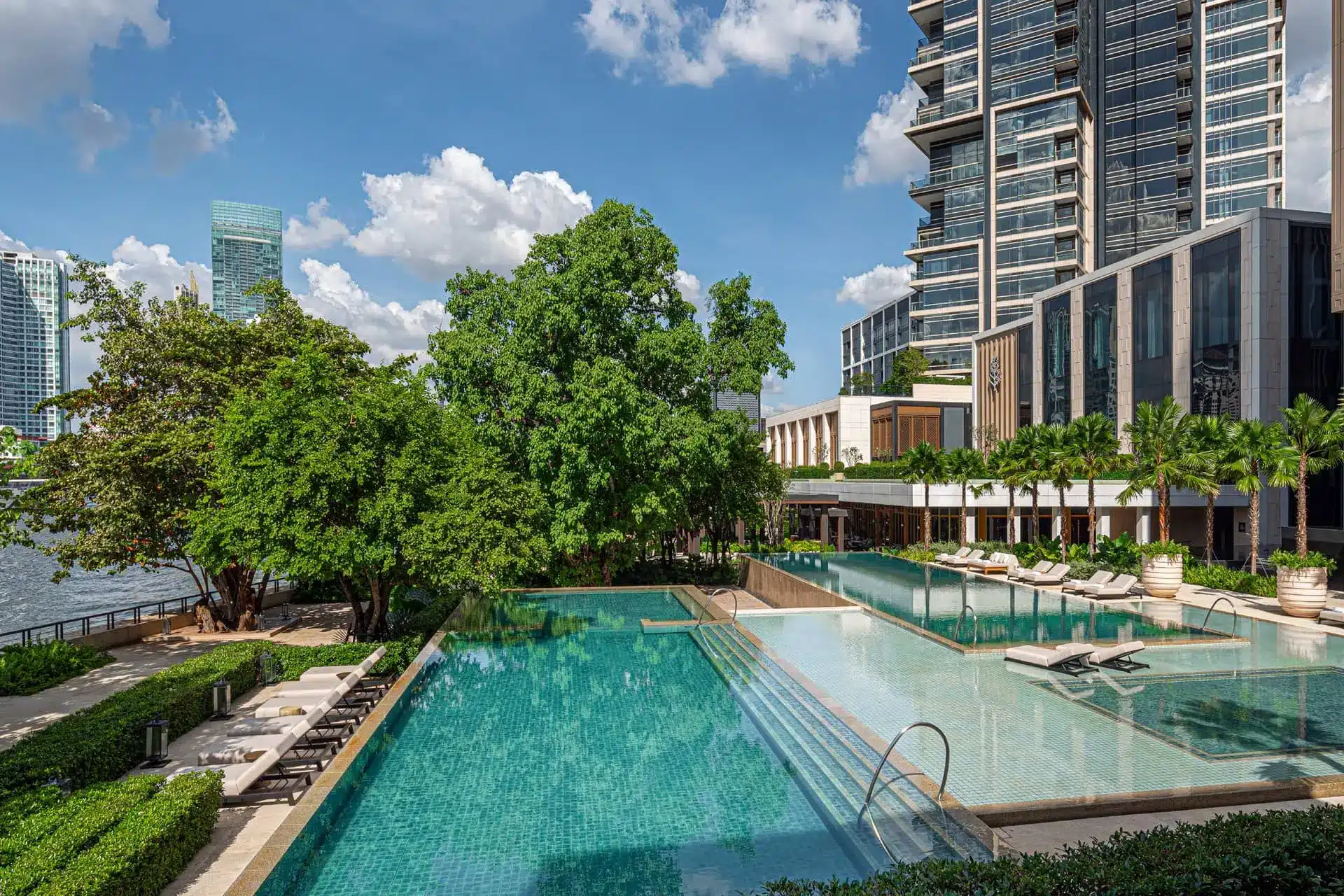
The Chao Phraya is central to the experience at Four Seasons Hotel Bangkok. The property stretches along 200 metres of waterfront, giving Gathy and Denniston room to arrange it as a sequence of cascading buildings. Green courtyards and terraces break up the route through the hotel, while water features draw the river’s presence further into the grounds.
As guests move between buildings and courtyards, each transition opens onto a different aspect of the property. It gives this large urban hotel some of the ease of a resort, without losing the sense that Bangkok is just beyond it. For travellers who want to spend time at the hotel between trips out into the city, those outdoor spaces are a persuasive part of the stay.
Inside, high ceilings and glass walls bring daylight deep into the rooms. Water reappears throughout the property, so the Chao Phraya remains a point of reference as guests move indoors and out.
Four Seasons opened in 2020 and is the highest-ranked of the four hotels featuring Gathy’s work this year. Its No. 3 position also puts it just one place behind Capella Bangkok. The two share a riverfront setting, but at Four Seasons it is the succession of courtyards, buildings and changing views that defines the approach to the water.
Aman Nai Lert Bangkok, No. 48
Aman Nai Lert Bangkok draws on a much greener side of the capital. It stands within the seven-acre Nai Lert Park, with suites looking across the grounds and towards Bangkok beyond. Its first appearance in the top 50 comes at No. 48, making it the second Bangkok project featuring Gathy’s work on the main list.
A century-old Sompong tree sits at the centre of the design. Rather than treating it as something to admire only from a distance, the building makes room for it through an elliptical opening. The tree remains visible as guests move through the hotel, a living feature that gives the spaces around it their focus.
The nearby Nai Lert family home also informs the interiors. Natural textures sit alongside antiques and work by local artisans, bringing Thai craftsmanship into Aman’s restrained design language. Those details give guests a connection to the history of the site while they are inside a contemporary hotel.
The park setting carries through to the suites. Their views take in the trees first, with the city beyond them, so the prospect changes depending on where you look. The contrast is part of the appeal for a Bangkok stay: time among the greenery comes with the skyline still in sight.
Janu Tokyo, No. 52
Janu Tokyo sits in Azabudai Hills and leads the two Gathy-designed properties on the extended list, at No. 52. Its interiors move between quiet guest rooms and lively shared spaces, a contrast that suits a hotel designed for time alone as well as time spent among other guests.
In the rooms, hand-applied sakan plaster gives the walls a tactile finish. Warm, earthy tones keep the mood composed, while sliding panels conceal storage. It is a practical detail with a visible effect: possessions can be put away and the spaces left open and uncluttered, ready to return to after a day in Tokyo.
The atmosphere shifts in the communal areas. Colour and artwork come forward, and the dining spaces have richer detailing than the rooms. There is a clear change of pace between heading upstairs to rest and going out to eat within the hotel. Janu’s more sociable side has room to show itself without following guests all the way back to bed.
Its expansive wellness facilities add another option for spending time on the property. You could make the most of the shared spaces, then retreat to the quieter feel of your room; the design makes both choices seem comfortable. The balance between them gives Janu Tokyo a character of its own among the four hotels.
Aman New York, No. 87
Aman New York occupies the historic Crown Building on Fifth Avenue. Gathy’s design works with its Beaux-Arts character while bringing Aman’s quieter atmosphere into the interiors. At No. 87, it is the fourth hotel featuring his work in the 2026 rankings and the second on the extended list.
Muted colours and natural woods soften the transition from the prominent address outside. Layers of panelling are designed to soften sound throughout the interiors, an important detail in a hotel whose appeal includes spending time away from the pace of the street. The building’s heritage remains present, but the rooms have a calmer feel.
Every suite has a working fireplace. It is a distinctive detail for rooms high above Manhattan, bringing warmth to an interior shaped by subdued materials. At Aman New York, the quiet comes through in small decisions as well as the larger architectural ones, from the treatment of sound to the welcome of a fire in your suite.
Arrival has a different scale. A double-height space leads towards dining and social venues overlooking the city, opening the hotel back up to its Fifth Avenue setting. Guests can take in those views downstairs, then return to the muted rooms above.